
On April 1st, 2026, the Florida Space Coast witnessed the historic liftoff of Artemis II—the first mission to the moon since 1972. For two Eastern Florida State College instructors, the launch represented a moment both awe-inspiring and deeply personal.
“Knowing there’s four people on there and we’re going back to the moon was just incredible,” said EFSC Aerospace Technology Instructor Ed Mango. “The last time we were at the moon, I was 12 years old.”
Mango, who has been teaching aerospace technology courses for almost a decade, worked for NASA from 1982 to 2026 as a shuttle engineer, a legacy that still resonates to this day.
“I was the First Lead for the Ground Launch Sequencer, which is the software that actually launches the vehicle for Artemis,” said Mango. “Today, I teach a class called Aerospace Systems, which goes through every subsystem in a spacecraft or launch vehicle.”
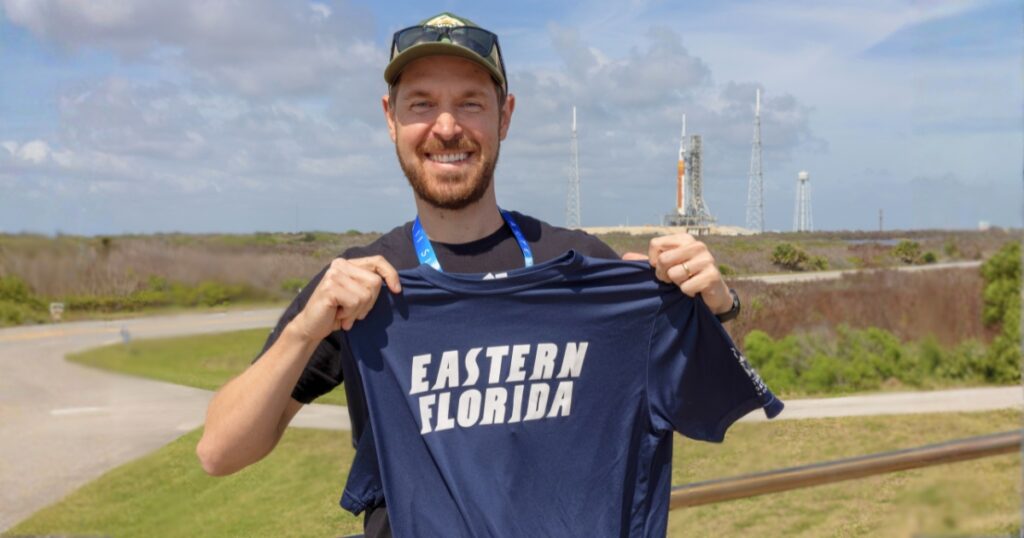
For EFSC’s Engineering and Science Assistant Professor, Wade Dauberman, the Artemis II launch brought together a lifelong interest in astrobiology and content creation when he applied for NASA’s Social program, a rare and limited opportunity for up-close coverage.
“I figured tons of people would apply. I was waitlisted,” said Dauberman. “And then I got an email saying my waitlist was accepted. I told my students ‘Class might be canceled because we’re going to the moon’!”
Dauberman, who has been teaching at EFSC since 2017, saw the invitation as yet another opportunity to bring his real-world experiences back to the campus, getting students involved and excited.
“Meeting other content creators showed me students learn in 30-second tidbits now,” said Dauberman. “Content creation allows me to bring education to livestreams, teaching others through multiple mediums beyond the physical classroom.”
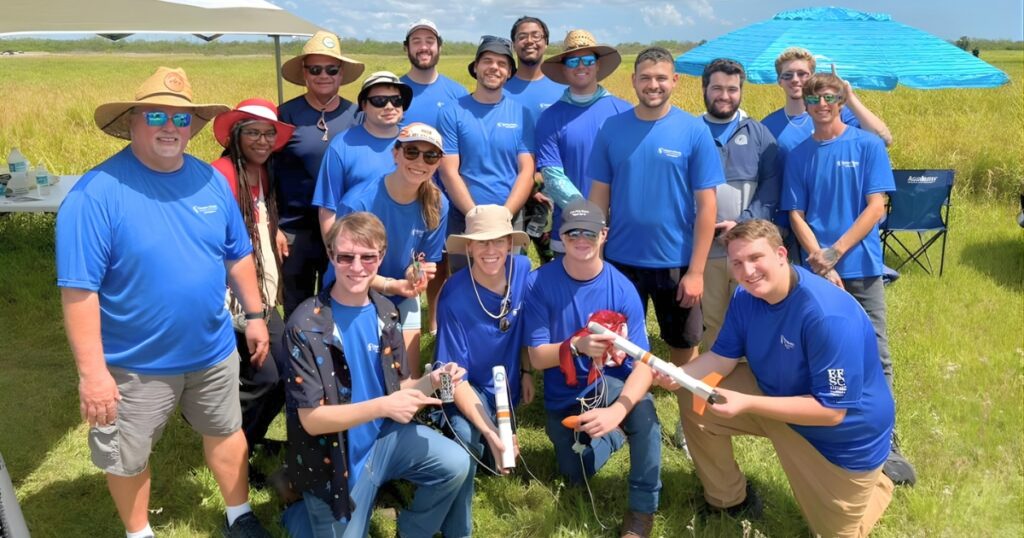
Building Up to the Launch
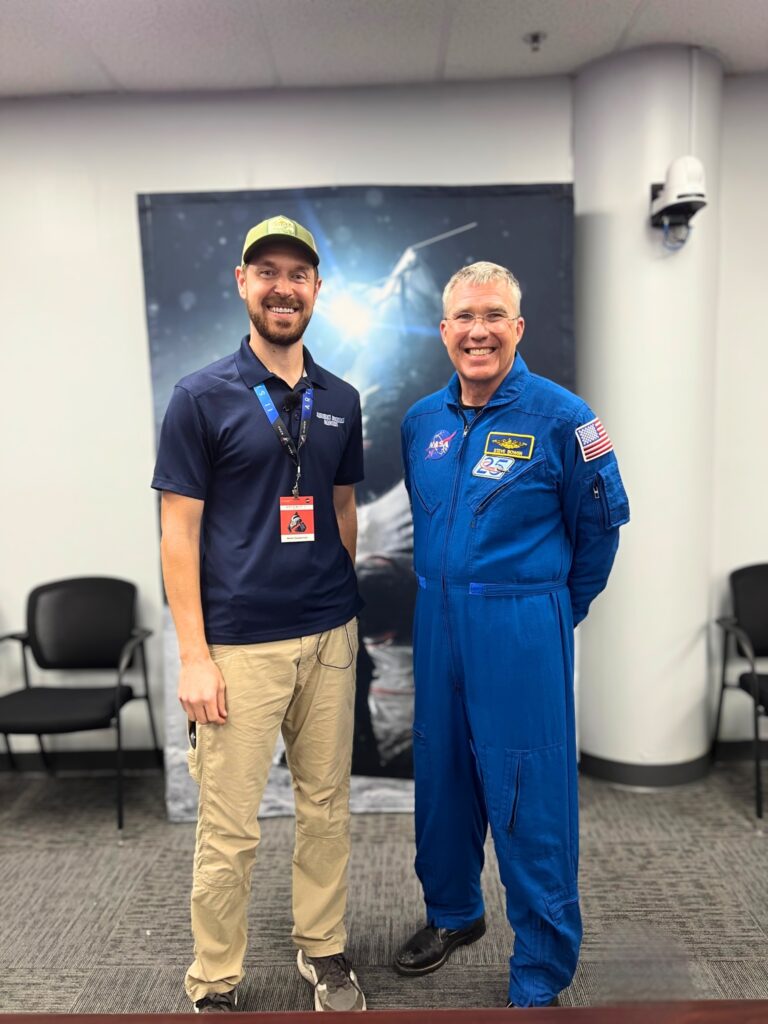
The NASA Socials event, which spanned two days, got Dauberman up-close with the NASA team, including Administrator Jared Isaacman and astronaut Steven Bowen.
“We had a whole bunch of one‑on‑one chances to chat with subject matter experts in lunar geology, radiation, and health. That was my favorite part,” said Dauberman. “For example, I learned about a human biology experiment called Avatar where they took bone marrow tissue from the astronauts to study the effects of radiation outside of low Earth orbit.”
Additionally, Dauberman and other content creators had the rare opportunity to explore the Vehicle Assembly Building.
“We also got to tour the crawler, the actual crawler that took Artemis to the pad,” he said. “We walked up and around it, which was really cool.”
While Dauberman covered the lead-up to the launch onsite, Mango covered the launch as a guest speaker on the About Space Today podcast, recording live from Gator’s Dockside in Port Canaveral. There, he offered expert insight, both as an EFSC instructor and former NASA First Lead, on the Orion spacecraft and the mission’s significance. The experience provided Mango with a new perspective of shuttle coverage.
“When I was in shuttle and public affairs at NASA, there was usually debriefing after a scrub or post‑launch,” he said. “This podcast was different. I was on the producing side now.”
The Moment of the Launch
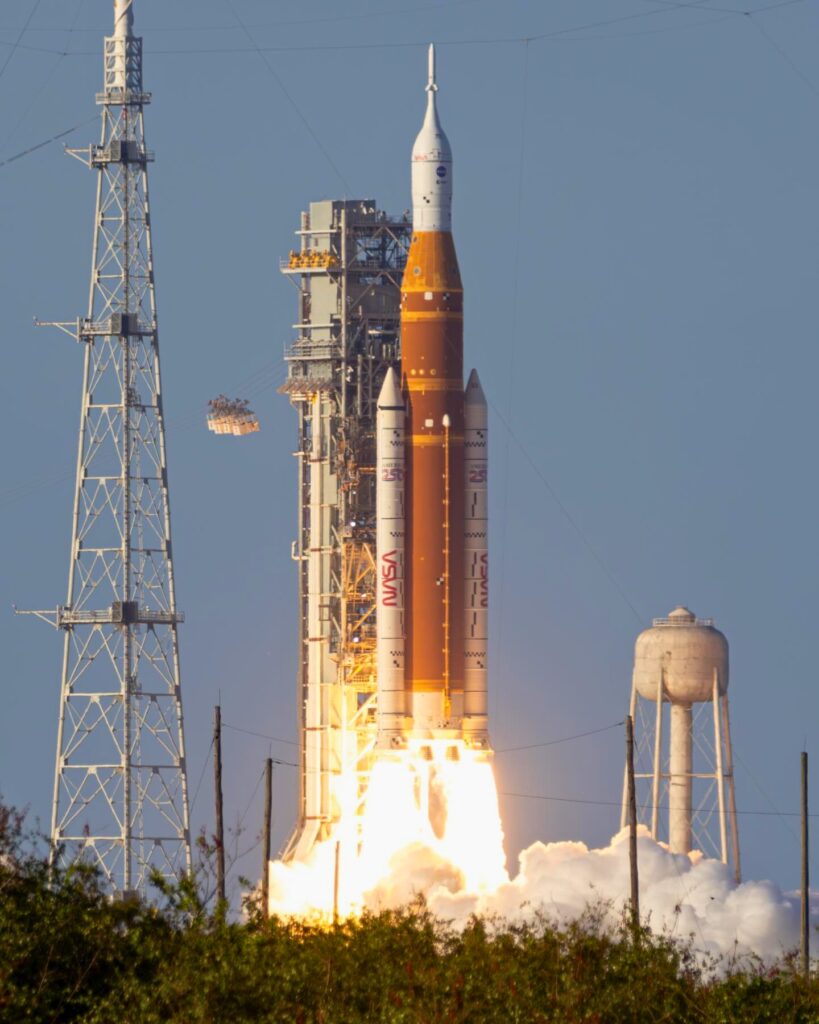
Minutes before launch, Dauberman found himself only 3.4 miles away from the pad, given an ideal filming spot as one of the nearest cameras to the action. As he recorded the experience, he could hardly contain his excitement.
“When it went – oh man. It’s hard to explain. It goes through your entire body,” he said. “It was like shock waves – you could feel the sounds.”
Meanwhile, at Gator’s Dockside, Mango heard a familiar voice over the live Artemis II firing room communications, an engineer he personally trained back in 2016.
“This was his first mission as Launch Pad Engineer,” said Mango. “I got to hear him in the loop, and he and his team were doing outstanding.”
Onsite at the launch, Dauberman described a scene of spontaneous joy as people all around him experienced history-in-the-making first-hand.
“Everyone there was cheering, going wild afterwards,” he said. “Lots of people were crying. It was a wild experience. That excitement – that’s big.”
Mango listened as excitement gradually built toward the big moment when the Solid Rocket Boosters detached from the rocket.
“As it was getting closer to SRB separation, this chant started. Within about 20 seconds the entire restaurant was chanting ‘USA, USA, USA!” said Mango. “You don’t get that in the firing room. That energy – that made the whole thing worthwhile. That was probably one of the coolest things I’ve ever seen at a launch.”
EFSC: A Pipeline to the Space Coast
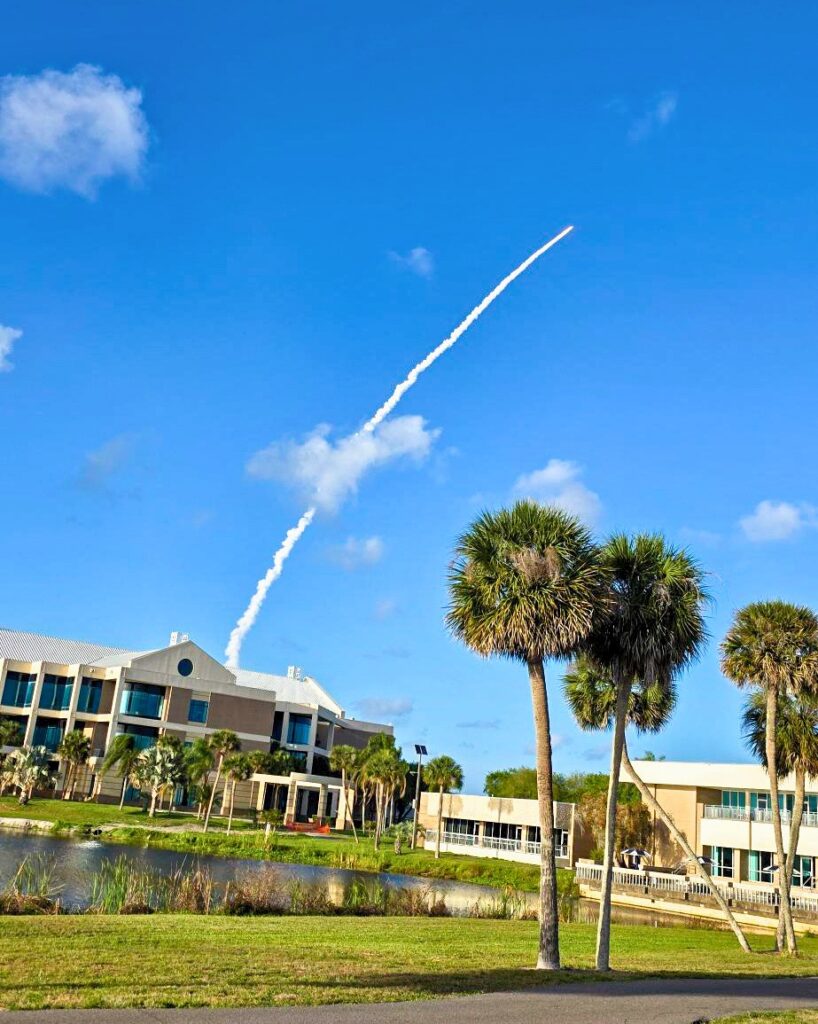
“Having our instructors stand on the front lines of an Artemis II launch reflects the real-world relevance of our aerospace program,” said College President Dr. Jim Richey. “It’s a powerful reminder of EFSC’s continued contribution to workforce development, preparing the skilled workforce that fuels careers at Kennedy Space Center and the future of exploration.”
For Mango, the launch presents a monumental opportunity to ground students’ experiences in current events.
“I don’t like to teach via textbook. I prefer examples from the real world,” he said. “My career was mostly low Earth orbit. Theirs are going to be beyond Earth orbit.”
As students graduate from EFSC’s aerospace program, they enter careers with industry giants like Boeing, Lockheed Martin, and NASA.
“About 90% of them get jobs before the graduate, and the other 10% get jobs after they graduate,” said Mango. “Some even choose to continue education into higher engineering degrees.”
Reflecting on the historic Artemis II launch, Mango anticipates the motivation it will give the students of today to become the space pioneers of tomorrow.
“EFSC students are the future of human space flight,” he said. “This generation is going to know that we can go to the moon.”