
Located on Eastern Florida State College’s Cocoa Campus, the Interactive Media Production Technology A.S. degree prepares students to enter Florida’s booming audio-video industry.
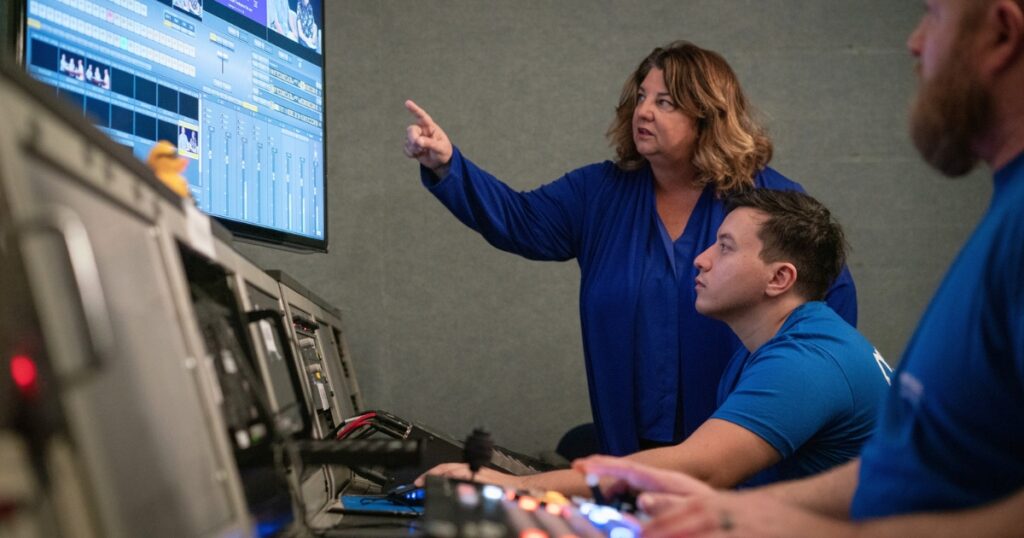
“This program is where creativity meets technology. It’s about engaging the viewer through media,” said instructor Karla Roberts, who has over 30 years of experience in television, radio, and media development.
Combining photography, data analytics, audio-video technology, social media, and more, the program teaches students industry-aligned tools like Adobe Creative Cloud Suite alongside hands-on experience with production equipment. Throughout the program, students build a portfolio of projects designed to prepare them for jobs in fields like marketing, production, journalism, television, and animation.
“This is a ‘do’ classroom—not a ‘sit‑and‑listen classroom’,” said Roberts. “You’re making three videos in a semester. It’s a very project-based program, and I let those projects be driven by students’ interests.”
Offering a mixture of on-campus and online hybrid courses, the program intentionally mimics the virtual nature of the media industry. Graduates often enter the field directly upon completion. Others pursue a subsequent bachelor’s program at EFSC, or transfer to another school to continue their education.
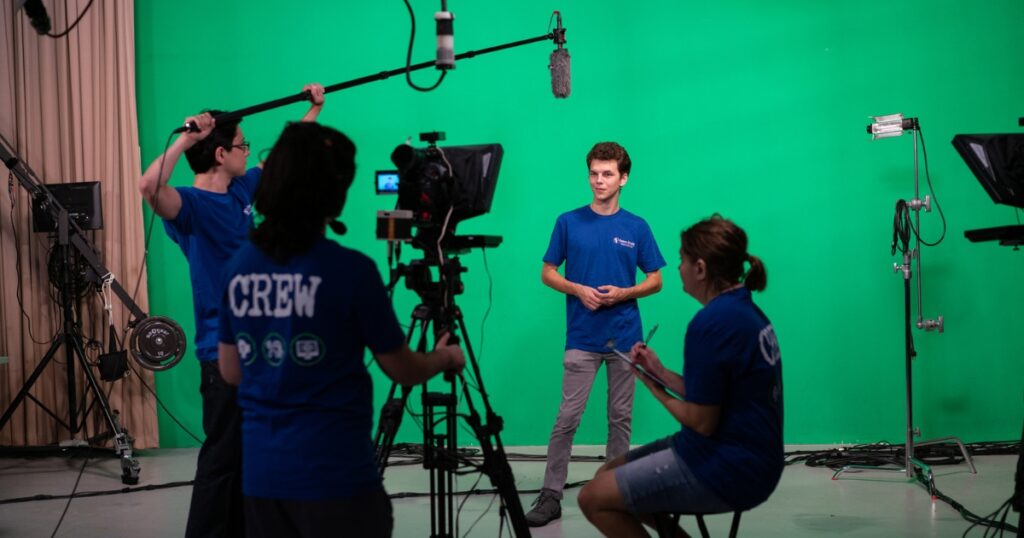
Hands-on Experience in Industry-Grade Studios
Students have access to a wide range of hands-on experiences, including EFSC’s professional public television station, WEFS-TV. There, they can intern for elective credits toward their degree.
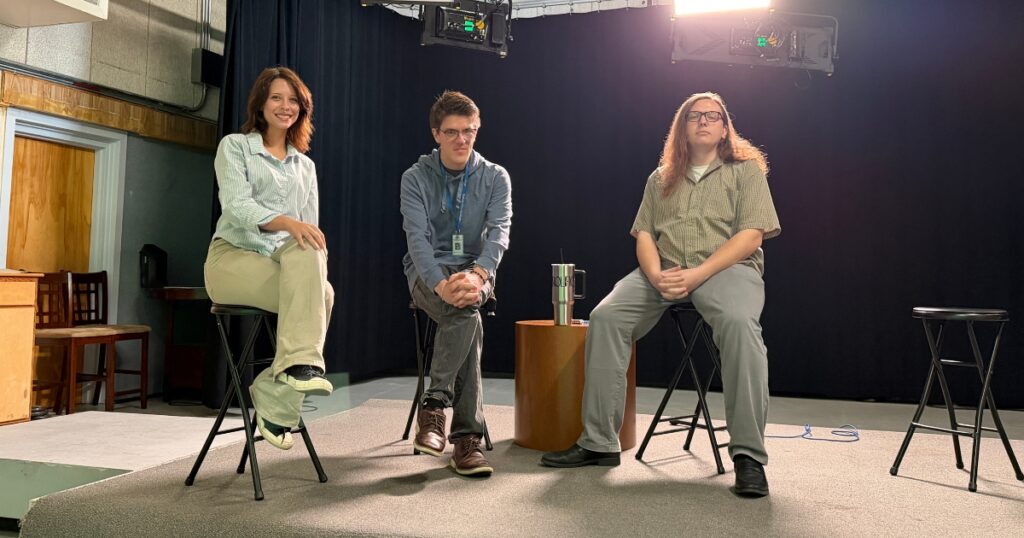
Classroom projects leverage the on-site Digital Media Lab, comprised of a dedicated video studio, two photography studios, broadcast equipment, professional cameras, lighting gear, green screen technology, and a talk-show-interview styled set.
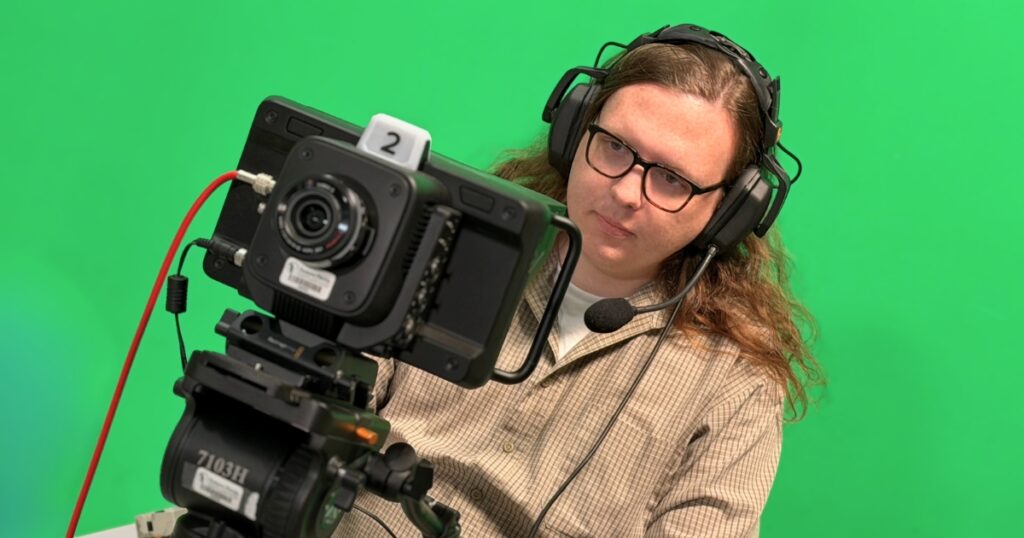
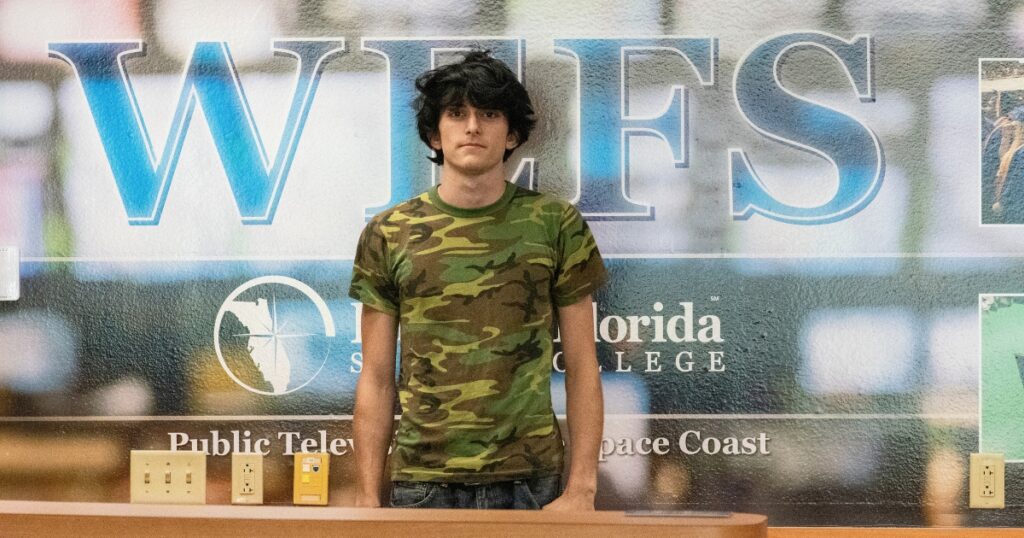
“You really get familiarized with the process of being involved in a live broadcast,” said Cameron Webb (featured image student), who is simultaneously completing his degree and a work-study experience at WEFS-TV. “The studio classes I took set me up with the skills that I’m using now at WEFS. That’s made it possible for me to step into the role with confidence.”
Peer Networking and Support
Additionally, the program encourages internal networking. Students collaborate on each other’s projects-in-progress and assist with media-related needs in the community.
“The class is such a friendly, positive environment,” said Webb. “Everyone wants to help each other learn.”
This year, for example, students filmed b-roll and highlights for EFSC’s Backyard BBQ Cook-Off and Family Fest, which attracted over 2,000 attendees.
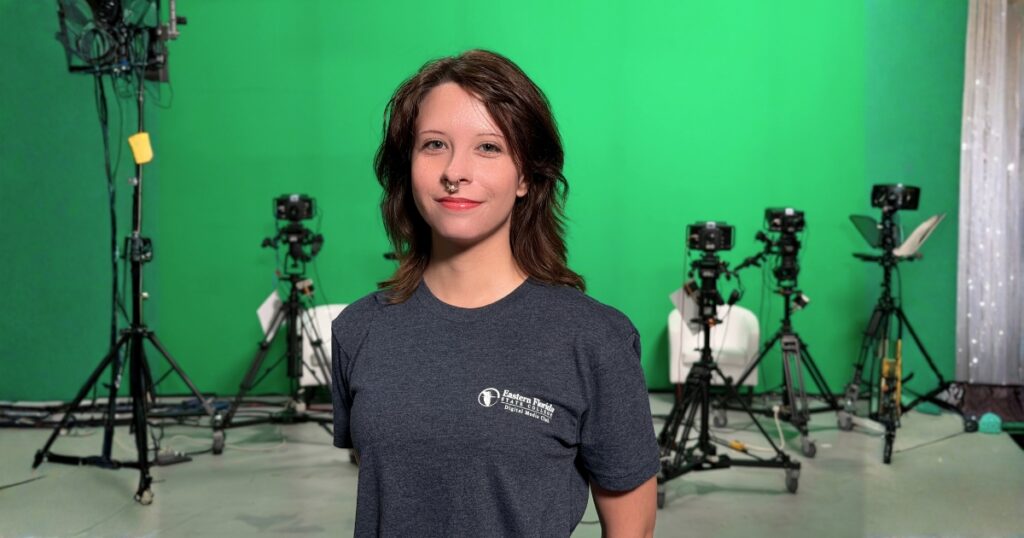
Rae Gallaway, who fell in love with filmsets first-hand while watching her dad work behind-the-scenes for major studios, transitioned from an associate in arts degree to Interactive Media after taking its photography course. Though only in her first semester, she’s already engaging clients like the Eau Gallie Arts Distract, shooting advertisements for small businesses while simultaneously producing her own creature-feature short film.
“Humans have always been storytellers,” said Gallaway. “Filmmaking is an extension of that. When you consume media, you connect with it, and there’s nothing else like that. People will always chase that connection. That’s why media matters. I’m working with some incredible people. They have experience in practical effects and they’re super excited to see what we can pull off.”
Professional Networking and Film Festivals
During the program, students have opportunities to attend and submit their films to regional and national festivals like Melbourne Independent Film Festival, Sunscreen Film Festival, Sundance Film Festival, and NASA’S HUNCH program. In addition to building students’ professional portfolios, these festivals allow students to meet industry experts and participate in workshops to hone their directing, pitching, scripting, and producing skills.
“Students pitched their films to real producers last year,” said Roberts. “A writer from the Netflix series Arcane spoke to our students for over two hours and even offered to review their scripts.”
Last year, Interactive Media students at Eastern Florida State College participated in the global 48-Hour Film Project, premiering their film “Missfortune” in a local theater with City Producer Christina Lynn Carmona in attendance. This 2-day filming challenge was made possible through collaboration within the Titans Digital Media Club.
“I highly recommend anyone in the program join the club,” said Galloway. “The networking is invaluable.”
Additionally, Interactive Media student Jared Ditman in collaboration with the EFSC Digital Media Club, had two short films accepted into the 2026 Sunscreen Film Festival in St. Petersburg, Florida. One of the films Ghost Investigations: Curse of Bermudez Manor was produced as part of his coursework in Advanced Field Production.
“Having two films accepted into a nationally recognized festival is an outstanding accomplishment,” said Roberts. “It truly highlights the creativity, collaboration, and technical skills being developed within EFSC’s Interactive Media program.”
“Humans have always been storytellers,” said Gallaway. “Filmmaking is an extension of that. When you consume media, you connect with it, and there’s nothing else like that. People will always chase that connection. That’s why media matters.”
Career Pathways and Diverse Fields
David Simpkins’ lifelong passion for “skate culture” kickstarted his interest in film and street photography. Now in the final semester of his degree, Simpkins has produced a portfolio of studio projects, including interviews with local creatives and members of the skate community.
“You can always tell when someone takes their time and is passionate about what they do,” said Simpkins. “I try to let these projects consume my time. That’s the only way to get good.”
Post-graduation, Simpkins is aiming for a camera operation role—possibly one that merges his love for skate culture with studio-grade production. He credits his classmates and teachers for helping him pursue his niche.
“College is the time to break out of the mold and try new things,” he said. “I wouldn’t have made any of these projects without the class pushing me.”
Interactive Media graduates may enter a variety of media-related fields. Roles include social media marketing, training and development, UX design, photography, live broadcasting, film production, and more.
“We’ve had students working at WEFS, interning at Disney, winning NASA’s HUNCH video challenge, and earning placements with organizations like the American Space Museum and major media companies,” said Roberts. “One of my graduates got his dream job. He works for three different car magazines doing their social media.”
While encouraging students to pursue their niche, Roberts advises developing a range of skills to meet the market’s diverse needs.
“Some days I’m making graphics, some days I’m writing scripts, some days I’m in the field doing video,” said Roberts. “Every day is different. And that’s what I love about this field.”
Training a Generation of Media Experts
“Our Interactive Media Technology A.S. degree is a hybrid of hands-on experience, cutting-edge studio equipment, and student-driven creativity, “said College President Dr. Jim Richey. “Students benefit greatly from faculty like Karla Roberts with decades of industry experience. We are proud of this program and the creators of tomorrow it launches.”