
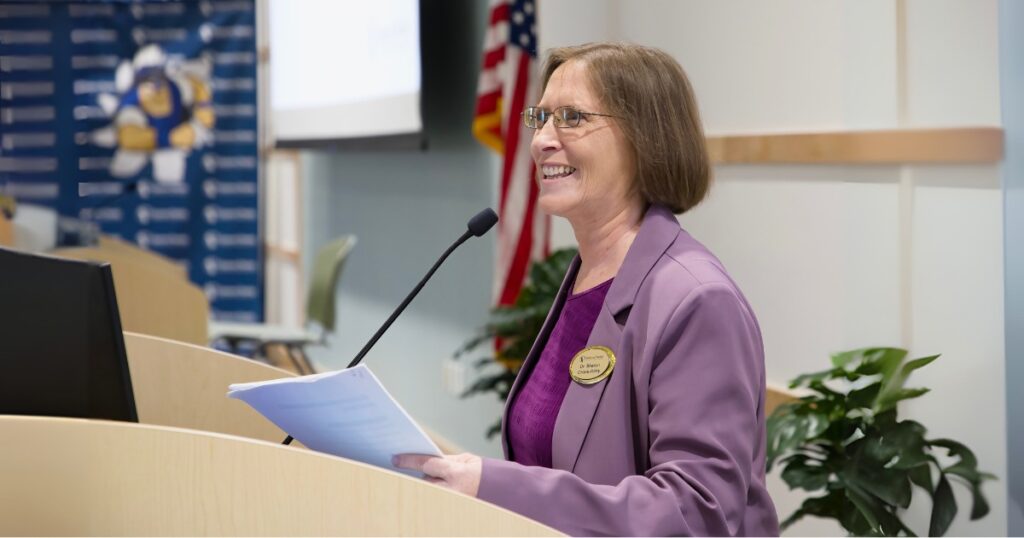
When Dr. Sharon-Cronk Raby accepted her first teaching role at a middle school in Chicago, she never imagined the experience would ultimately lead to a presentation at the 2025 Mental Health for Schools Summit in New Jersey, speaking alongside Yale University’s Dr. Marc Brackett.
“I have two focuses: teaching mental safety in the classroom — to both students and educators,” said Cronk-Raby.
Today, she serves as the Dean of Arts & Sciences at Eastern Florida State College, where her passion for emotional intelligence and person-centered learning fuels a mission to help students achieve their academic and professional goals.
Cultivating a Passion for Community College
Dr. Cronk-Raby credits her love for community colleges to her “late start” — enrolling in her degree program when she was 25 years old.
“I didn’t know what I wanted to do. At the time I hadn’t heard of a community college,” said Cronk-Raby. “But going to a community college helped me get my start, transitioning into where I am now.”
After completing a bachelor’s in English and a Teaching Certification at Elmhurst University, Dr. Cronk-Raby completed a master’s degree in English at Governor’s State University, followed by a PhD in Psychology with an emphasis in Cognition and Instruction at Grand Canyon University.
“Psychology is about influence — identifying the many influences on our lives. English gives us a path to understanding and expressing those influences,” said Dr. Cronk-Raby. “When we write and read, we not only understand ideas, but we’re able to put them into practice.”
Empowering Students through Emotional Intelligence
A theoretical turning point in Dr. Cronk-Raby’s doctoral research on writing anxiety occurred through the influence of Dr. Mark Brackett of the Yale Center for Emotional Intelligence. He introduced her to “RULER” — an acronym for Recognize, Understand, Label, Express, and Regulate emotions.
“Emotional intelligence is about understanding our thoughts, brains, and emotions,” said Dr. Cronk-Raby. “College students are often trying to figure out who their role models are, who to mirror emotionally, and how to properly express their needs — especially when they have feelings that don’t match the group’s feelings.”
With this expertise, Dr. Cronk-Raby has led Emotional Intelligence workshops for EFSC’s Healthy Body, Healthy Mind and Navigators to Success. The latter helps students with an Autism Spectrum Disorder (ASD) transition to college life.
“It’s about empowering students’ bravery,” said Dr. Cronk-Raby. “Extreme emotional responses often lead to misinterpretation. In this workshop, I help students understand social conventions. They learn to express their ideas clearly, as well as understand the emotions of others.”
Speaking at the Mental Health for Schools Summit

On November 10-11, 2025, Dr. Cronk-Raby will speak at the Mental Health for Schools Summit. Held annually, this conference invites educational leaders, thought leaders, researchers, teachers, mental health professionals, and community stakeholders to engage with prominent figures in the mental health and education sectors.
Her session, titled “Transitioning WHAT I Teach into WHO I Teach,” distills years of experience studying emotional intelligence into a practical process. Educators can use this process recognize anxiety’s impact on students and manage it through daily teaching methods.
“People should come first,” said Dr. Cronk-Raby. “As educators, we must understand that when students walk into classrooms, they arrive with prior influences. Educators join as an influence in students’ academic, professional, and personal pursuits.”
Case in point: Cronk-Raby teaches English. However, her goal is to teach people how to better master the English language as individuals.
“Yes, curriculum and state standards are important and aren’t to be diminished,” she said. “But we sometimes get so focused on the ‘what’ that we forget we have people sitting in front of us — people with all kinds of interests and abilities. And they get lost because we’re so focused on what percentage of students met this goal.”
Dr. Cronk-Raby recognizes that students’ proficiency levels and goals differ. Not every student will become a field specialist. Educators best assist students by conveying information so that students can apply it practically to their individual lives.
“I’ve learned that when we focus on the people, the curriculum all falls into place.”
Using her previous research on writing anxiety as a basis, Dr. Cronk-Raby will present her findings using theories from Bronfenbrenner’s Ecological Systems Theory and Piaget’s schema development.
“Ecological Systems theory is about how we have layers of influences. Some people are static in our lives and others come and go, but everyone we interact with is an influence,” said Dr. Cronk-Raby. “Piaget’s schema development then says that because we’re influenced by things, we develop patterns of telling ourselves things like ‘I’m not a good writer,’ when maybe you could be a great writer. You just haven’t let yourself discover that yet.”
Therefore, by influencing their students via a people-focused growth mindset, educators have the empowering ability to shape students’ beliefs and outcomes.
Traveling Overseas to Present in London
Already eyeing future speaking opportunities, Dr. Cronk-Raby recently accepted an opportunity to present at the November 2025 Coaching, Kindness, and Culture: Ted Lasso, Psychology, and the Art of Leadership conference at the London Arts-Based Research Centre in England.
In preparation, she has adapted her emotional intelligence research — specifically the concept of students having a “trusted ally” to mitigate writing anxiety — to the conference’s theme.
“During my presentation, I’ll definitely be joking that the Ted Lasso show must have seen my research,” she said. “It fits so well with the show’s themes, with him serving as a ‘trusted ally’ to others in the story.”
Preparing Students to Navigate Life
In her role as Dean of Arts and Sciences at EFSC, Dr. Cronk-Raby puts her research into practice. She works alongside talented faculty and staff to create a positive, influential experience for students.
Her advice for students: “Be mindful of your surroundings — because everyone and everything influences you. You can’t always choose who you work with, but you can use emotional intelligence to work well, wherever you are.”
When it comes time management and chosen associates, however, Cronk-Raby encourages discernment.
“Pick the people and things that are most important to you. This puts you in control of your journey, life, goals, and emotions,” she said. “This is how you control your processes and outcomes.”
Her goal is to create supportive foundations for students by surrounding them with trusted allies who help them find self-realization and maintain momentum toward their goals. It all starts with emotional intelligence.
“Success, maturity, and professionalism are not about suppressing our emotions, but regulating them,” said Dr. Cronk-Raby. “If we don’t control our emotions, they will control us. Emotional intelligence helps students navigate more than just academics — it helps them navigate the rest of their lives.”
- Former EFSC Athlete Makes Debut in Major League Baseball - September 28, 2026
- Producing Success: How EFSC Prepared Enrique J. Molinares for a Career in Media Production - July 1, 2026
- EFSC Student Finds Community and Achievement through Music - June 24, 2026