

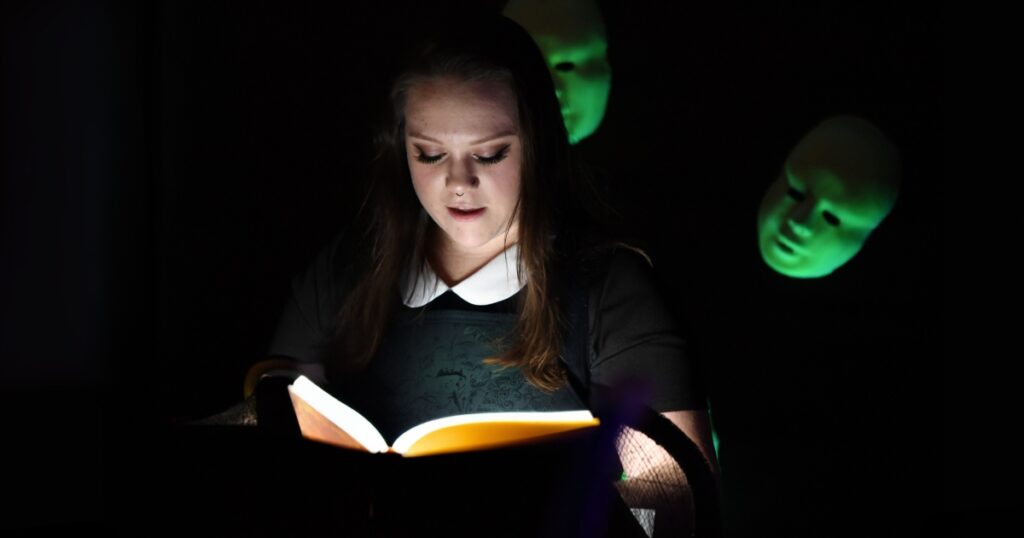
Why read classic horror stories? Not only do they give us a deeper understanding of what it means to be human (including our greatest fears), but they also allow us to experience life from another perspective. Our critical thinking, appreciation of truth, and ability to grasp complex ideas all improve. Several scientific studies have drawn correlations between reading and improved attention spans, boosted brain health, better vocabularies, and improved writing skills (to name a few).
With spooky season approaching, here are 10 classic literature novels (as short as 30 pages!) for a “spirited” mood.
1. “Jane Eyre” (Charlotte Bronte)
Far from a cozy romance, “Jane Eyre’s” foray through a seemingly haunted estate with a proverbial monster in the attic makes this novel a masterclass in gothic suspense. Between its plot twists and the characters’ psychological depth, it draws readers into forbidden, locked rooms and explorations of madness.
2. “Dracula” (Bram Stoker)
Vampire lit remains as popular as ever — and “Dracula” is the novel that helped launch the genre into the mainstream. This classic horror story of good versus evil features gripping suspense, “found-footage-style” mystery, and an ensemble cast. A hybrid of Gothic vampiric lore and Victorian-era technology, “Dracula” creates an evocative atmosphere of genre-defining dread and intrigue that will keep you turning its pages.
3. “The Picture of Dorian Gray” (Oscar Wilde)
When is beauty deadly? In this tale of vanity, betrayal, and murder, a young man makes a Faustian deal to preserve his youthful looks. As he commits atrocities, his portrait grows ugly while he remains outwardly pure and untouched by his own evil. In a modern era where physical appearance is easily filtered and faked, “Dorian Gray” provides a haunting warning about the dangers superficial charm and morality.
4. “The Hound of the Baskervilles” (Sir Arthur Conan Doyle)
Sherlock Holmes may not have pioneered the detective novel, but he’s undoubtedly the genre’s most famous character. The Hound of the Baskervilles stands the test of time as Sherlock’s most re-told story — a murder mystery involving a family curse, haunted moors, and (of course) a killer dog.
5. “The Strange Case of Dr. Jekyll and Mr. Hyde” (Robert Louis Stevenson)
Inspired by his nightmare, Stevenson wrote this science-meets-the-supernatural classic that can be read in only a of couple hours. The titular Dr. Jekyll splits his psyche, creating a dual being of pure good and pure evil, as the story dares to question what morality means to the human experience. A detective mystery wrapped in suspenseful setpieces, this short story will engage readers who love wrestling with themes of evil, identity, and mania.
6. “The Sandman” (E. T. A. Hoffman)
An inspiration for Freud’s “uncanny valley” and modern horror tropes of misleading narrators and sentient dolls, this short story explores one man’s childhood phobia of the mythical Sandman. At only 30 pages, this one-sitting story guides readers through a descent into unsettling reality and eventual madness, set against a backdrop of dark Romanticism.
7. “Frankenstein” (Mary Shelley)
Written by an 18-year-old Mary Shelley, “Frankenstein” gained famed as arguably the first true science fiction novel. Following the massive footsteps of its tragic, Byronic Monster, the story delves into themes of playing god, social isolation, and the ethical boundaries of scientific research. Both the philosopher and horror buff will appreciate this dark tale, as the Monster wrestles with rejection by his own creator and eventually turns against him in a terrifying game of cat-and-mouse.
8. Short Stories of Edgar Allen Poe
With around 70 short stories to choose from, you’re sure to find something that fits your flavor of frights. Here are a few:
- “Hop-Frog” — A precursor of the horror-clown trope, a court jester executes a grotesque act of revenge during a crowded masquerade.
- “The Black Cat” — Mania leads to murder, and a black cat haunts a guilt-ridden conscience until its evil deeds are exposed.
- “The Tell-Tale Heart” — Perhaps Poe’s best-known work, a victim’s heart drives its killer to madness.
- “The Pit and the Pendulum” — A condemned man escapes a series of death traps designed to physically and psychologically torment his soul.
- “The Fall of the House of Usher” — The master of a decaying mansion faces the living dead that he buried.
9. “War of the Worlds” (H. G. Wells)
“Attack on Titan” meets Stephen King. In this terrifying account of an apocalyptic invasion, humanity is forced into the claustrophobic underground to survive giant predatory aliens. The story blends the historical backdrop of 1890’s Victorian London with themes of cosmic horror and human mortality.
10. “The Turn of the Screw” (Henry James)
Ambiguity makes “The Turn of the Screw” a read that haunts the mind long after its final page. Are the two young orphans staying at the lonely Bly estate being possessed by the ghosts of two former residents? Or is the orphans’ governess caretaker merely falling into madness after encounters with these lingering spirits? A classic in unreliable (or is it?) narration, this 120-page tale unnerves with its gradual psychological tension.
Ready to Read?
You can find classic horror stories like these (and more) in your EFSC campus library’s book and audiobook collection.
Looking for more classic literature recommendations? Don’t miss our list of 10 Classic Literature Novels to Read in College!
DISCLAIMER: All views and recommendations expressed in this post are the author’s own and do not represent the opinions of Eastern Florida State College or its leadership.

- 5 Reasons to Volunteer While in College - February 4, 2026
- New Smiles Ahead: EFSC to Expand Dental Programs for Students & Community - January 14, 2026
- EFSC Composes Foundation for Student’s Music Education Career - November 19, 2025